Major psychiatric disorders, such as Schizophrenia, Bipolar Disorder and Major Depressive Disorder, are characterized by substantial genetic and phenotypic heterogeneity. In terms of genetics, evidence suggests that different types of genetic variants (i.e. common polymorphisms, copy number variants, rare coding mutations) are involved in the development of psychopathology.
With regard to schizophrenia, it has been conceptualized that multiple implicated risk variants converge in well-organized gene networks or molecular pathways, implying that genetic risk variation for schizophrenia may cause functional alterations within specific biological pathways, which in turn could significantly increase disease vulnerability. Several such pathways could be compromised by genetic defects in each patient, highlighting the importance of genetic heterogeneity in schizophrenia.
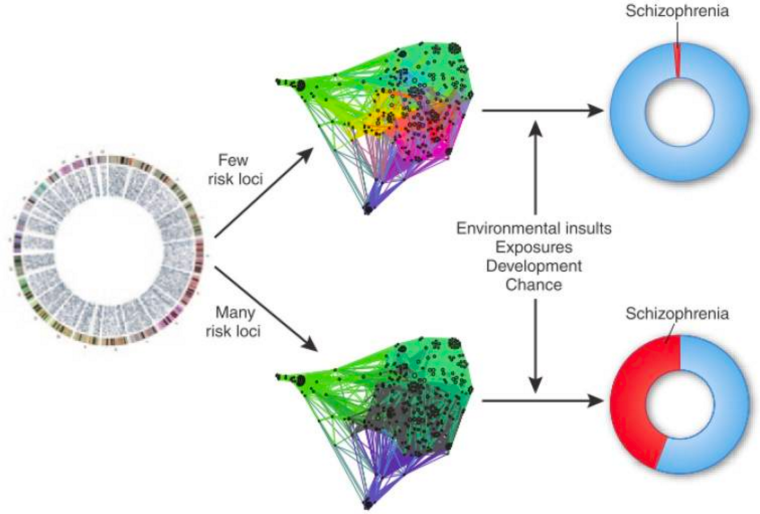
> Schematic of schizophrenia as a pathway disease: Genetic variants at many loci encode the components of a pathway or pathways. Many risk loci can be affected, resulting in a disease pathway greatly modified owing to polygenetic variation (from Sullivan PF, Nat Med2012).
Prior research findings from our group support the above notion by demonstrating that rare mutations within genes coding for proteins regulating the neuregulin signaling pathway may cluster in a subset of schizophrenia patients and plausibly contribute to the development of psychotic symptoms (Hatzimanolis et al., 2013).
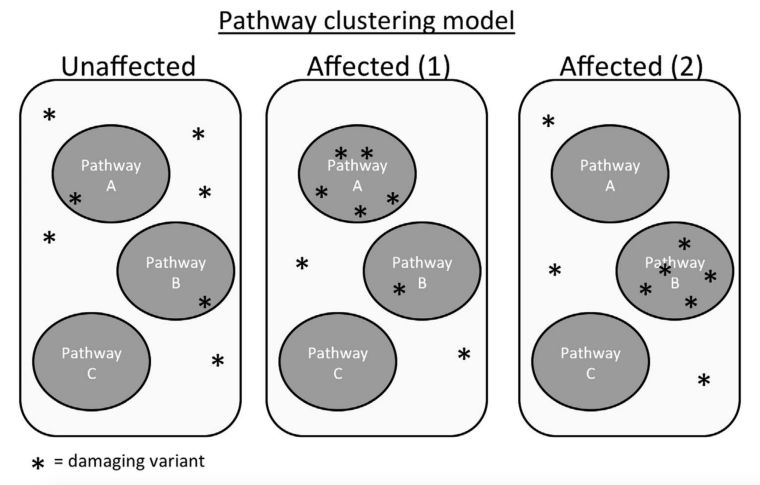
Our proposed model, termed “Pathway Clustering Model”, suggests that schizophrenia patients most likely carry a greater number of deleterious genetic variants within a given biological pathway compared to non-psychotic individuals. The observed ‘clustering’ of variants may represent a genetic risk factor for schizophrenia, particularly among familial cases.
> Schematic representation of Pathway Clustering Model for Schizophrenia: Clustering of multiple protein damaging variants within different well-defined molecular pathways could represent an unrecognized factor of schizophrenia risk and phenotypic heterogeneity (from Hatzimanolis et al., Transl. Psychiatry 2013).
 MGENE LAB
You must be logged in to post a comment.